Social Media DOES impact number of Views in a Scientific Article
A recent article was published in Circulation “A Randomized Trial of Social Media from Circulation” that concluded “A social media strategy for a cardiovascular journal did not increase the number of times an article was viewed”. Social Media use involved postings on the journal’s Facebook and Twitter feeds.
 Social Media is not about just posting, sharing and retweeting. There are many variables that play an important role on how social media would impact a particular outcome. 1) Who is doing it? 2) How many followers the individual have and what type of followers are they. 3) Timing is key, there are studies out there showing when is the correct time to use Twitter, Facebook, Linkedin, WordPress in order to get the most traffic. 4) In addition, articles should not only be available to physicians. We live in an empowering world, with intelligent patients that also want to learn about medical advances and many are more than fit to understand our articles even without a medical degree, this I guarantee. Therefore cost is definitely an issue and this is the reason why sometimes the summaries made in blogs regarding a particular article get thousands of more views than the original content.
Social Media is not just about posting, there is truly an interesting art behind it. From eloquent titles to intriguing eye captivating graphics. An fantastic platform that not many physicians are aware of is Reddit. This is a precious resource if you know how to use it properly but watch out there are also dark corners involved. In reddit just choose your particular field of interest (called a subreddit) and dig in. The Subreddit SCIENCE is particulary interesting, full of intelligent individuals who offer amazing knowledge in their discussions. Yes, also a lot of trolls but an interesting “world” nevertheless.
My point? Well my point is that Social Media does affect number of views and even though I congratulate the authors efforts I do not necessarily agree with them . Below you have an example of an article I was following in http://reddit.com/r/science. In the morning and then 6 hours later. It was coincidentally an article AHAJournals “Adherence to a Mediterranean Diet and Prediction of Incident Stroke”
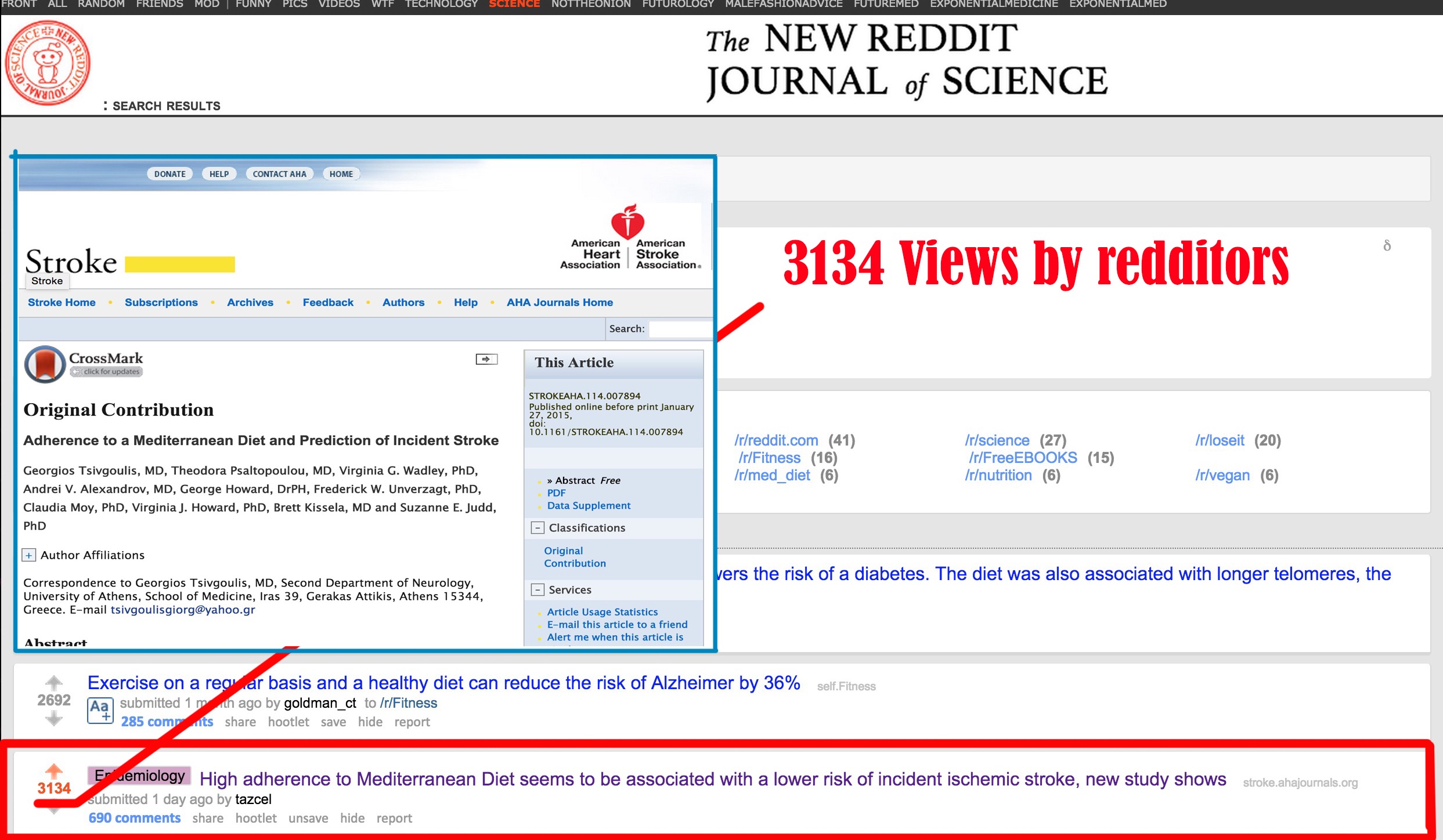
Just from reddit, this article got at least 133 views (people can upvote and downvote and article, number goes up and down depending on this). Now look 6 hours later how many people actually LIKED the post 3123. This means that thanks to reddit this article got at least 3123 views of which some of this individuals went to share the article in their own personal social networks.

This is just one example of how Social Media DOES impact how our findings and articles get seen.
In Places That Don’t Have 911, This App Finds The Closest Volunteer To Save A Life
If you’re crossing the street in Dhaka, Bangladesh, and you’re hit by rickshaw or a minibus, you can’t call 911, because it doesn’t exist. Without emergency services, injuries that are theoretically treatable can be fatal—for every one or two people in the U.S.
The Future of Medicine Is in Your Smartphone
Over the past decade, smartphones have radically changed many aspects of our everyday lives, from banking to shopping to entertainment. Medicine is next.
Imagining A Future When The Doctor’s Office Is In Your Home
Extracting medical care from the health care system is all too often an expensive exercise in frustration. Dr. Eric Topol says your smartphone could make it cheaper, faster, better and safer. That’s the gist of his new book, The Patient Will See You Now.
Live for ever: Scientists say they’ll soon extend life ‘well beyond 120’
In Palo Alto in the heart of Silicon Valley, hedge fund manager Joon Yun is doing a back-of-the-envelope calculation. According to US social security data, he says, the probability of a 25-year-old dying before their 26th birthday is 0.1%.
MDs & Patients! Please choose YOUR Telemedicine platform wisely!
2015 will be a huge year for Telehealth/Telemedicine. In the past, as physicians we have always allowed others implement the systems they want us to use and look were it has taken us.
Some might be happy others not so much. Regardless of your emotion we need to choose wisely when we choose the Telemedicine platforms we will be using.
As doctors, it is time we come together and make a wise decision on the platforms we will use in the future. The average debt for a resident at this point in time goes from 170 to 250K dollars. I see many platforms asking for these people in debt to give more for free. Why for free? Well it is simple but not the point of this post. I will elaborate in a later post on this.
For this post I want to emphasize some key points to avoid Doctors getting screwed one more time…
1) Telemedicine platforms are not here to “help” you as a doctor. Their main goal for them is to make money. If this was not the case then they would not be a business. It is estimated that Telemedicine in 2020 will reach an estimated value of USD 36.3 billion and business men want a piece of it. They all have to say they are here to improve healthcare. Blah blah blah. Let’s detach ourselves and see who is running the companies.
2) ALWAYS check the percentage they will take from the transaction and see if its fare. Probably not. If not Doctors need to stick together…
3) The Telemedicine platform is as good as the doctors enrolled. DO NOT ONLY CHOOSE ONE, ENROLL AS MANY AS YOU CAN. DO NOT GIVE THE POWER JUST TO ONE! Whichever platform benefits the patients and the doctors at a given time will be the choice.
4) Physicians are the only professionals that give their advice for free. Yes, we like to help people but we also like to help our families and provide for them. This comes from money. Try creating an application that asks lawyers to give their advice for free and see how hot it goes.
5) Let’s be blunt here. TIME IS MONEY and nobody works for free (almost nobody). Hey I am up for Pro Bono, but getting lured into a system of telemedicine where everyone wants to make money of the doctor. Not so much.
6) The truth is, if we want Telemedicine to be a pleasant useful tool for us as physicians we need to have a strong PRESENCE in how we practice it. THEREFORE, CHOOSE WISELY. If such platform does not exist, lets just start tweaking Skype, or hangouts, to avoid transaction fees. Microsoft, Google are you listening?
7) WHY IS FOCUSING ON THE PHYSICIAN IMPORTANT??????? Simple, because we all want a happy doctor to take care of us. If they use a platform that they are happy with this is far more likely. Look at all the negative articles out there talking about how frustrated doctors are with how healthcare is going. This is true because we are not truly represented. Doctors know what is best for the patients, trust me, and that is why many complain. Example Doctored: The Disillusionment of an American Physician

In general, what is good for the doctor is good for the patient and what is good for the patient is good for the doctor this is because these 2 entities are a team, a partenership (Unless your doctor is a “dbag” then this does not apply and vice versa). We need to stick together to make a change, its time we start doing it.
Over the last 18 months I have been working on a platform called Curely with 2 other entrepreneurs from Singularity University. This platform has been created by doctors and patients working together. We have tweaked it constantly and have been incorporating our physician’s recommendations. This is a platform that truly focuses on the PATIENT but it ALSO focuses on the DOCTORS. The best interest for both parties. If you are interested on Curely, you can find me at christian@prnize.com and/or christian.assad @ singularityu. com
9 jobs robots could replace in 2015
Walking through the city, I find myself thinking about all the jobs a robot could do. Could a robot drive that taxi, which just deposited a woman on Fifth Ave.? Probably, though I bet it wouldn’t be as good at multi-tasking.
Stretchy Artificial Skin Lets Prosthetic Hand Sense Heat, Humidity, and Pressure
Prosthetic limbs that can be controlled by an amputee’s thoughts or muscle movements already exist. But what if they could also sense the environment and then send that information back to the amputee’s nervous system?
Yale joins with leader in 3D organ printing to transform transplants
Researchers at Yale School of Medicine’s Department of Surgery and Yale School of Engineering & Applied Science have joined forces with a leading three-dimensional biology company to develop 3D printed tissues for transplant research.
Google is funding “an artificial intelligence for data science”
Google is funding a project called Automatic Statistician that bills itself as “an artificial intelligence for data science,” it announced Tuesday.

Christian Assad, MD Interventional Endovascular Cardiology

TikTok Humor

Videos
Amazon iFastLoCa Keto List

 El Rincon del Dr. KakaWate